AI-Assisted QA in Modern Game Development Workflows
Sergio Schiavo · · Game QA
AI-assisted QA is changing game development—but not by replacing testers. Its real value lies in capturing the context, evidence, and performance data teams need to understand and resolve issues more efficiently.

The biggest QA problem in modern game development is not that studios fail to find bugs.
It is that too many bugs arrive without enough context to fix them efficiently.
A tester reproduces an issue after a 40-minute session, but the exact trigger is unclear. A performance spike appears during combat, yet nobody captured the system state when it happened. A Jira ticket includes a screenshot and a short description, but engineering still cannot reliably reproduce the problem.
None of this is unusual.
As games become larger, more systemic, and increasingly interconnected, the cost of missing technical evidence grows across the entire production pipeline. QA slows down, engineering spends more time reconstructing issues, and triage becomes increasingly expensive.
This is where AI-assisted QA is starting to find a practical role in game development — not as a replacement for QA teams, but as a way to improve visibility across testing workflows.
Human QA Is Not Going Anywhere
The conversation around AI in game development often swings between extremes.
On one side, AI is framed as a revolutionary force that will fully automate game testing. On the other, many developers remain skeptical, viewing AI as another layer of production complexity added to pipelines that are already difficult to manage.
The reality is much more practical.
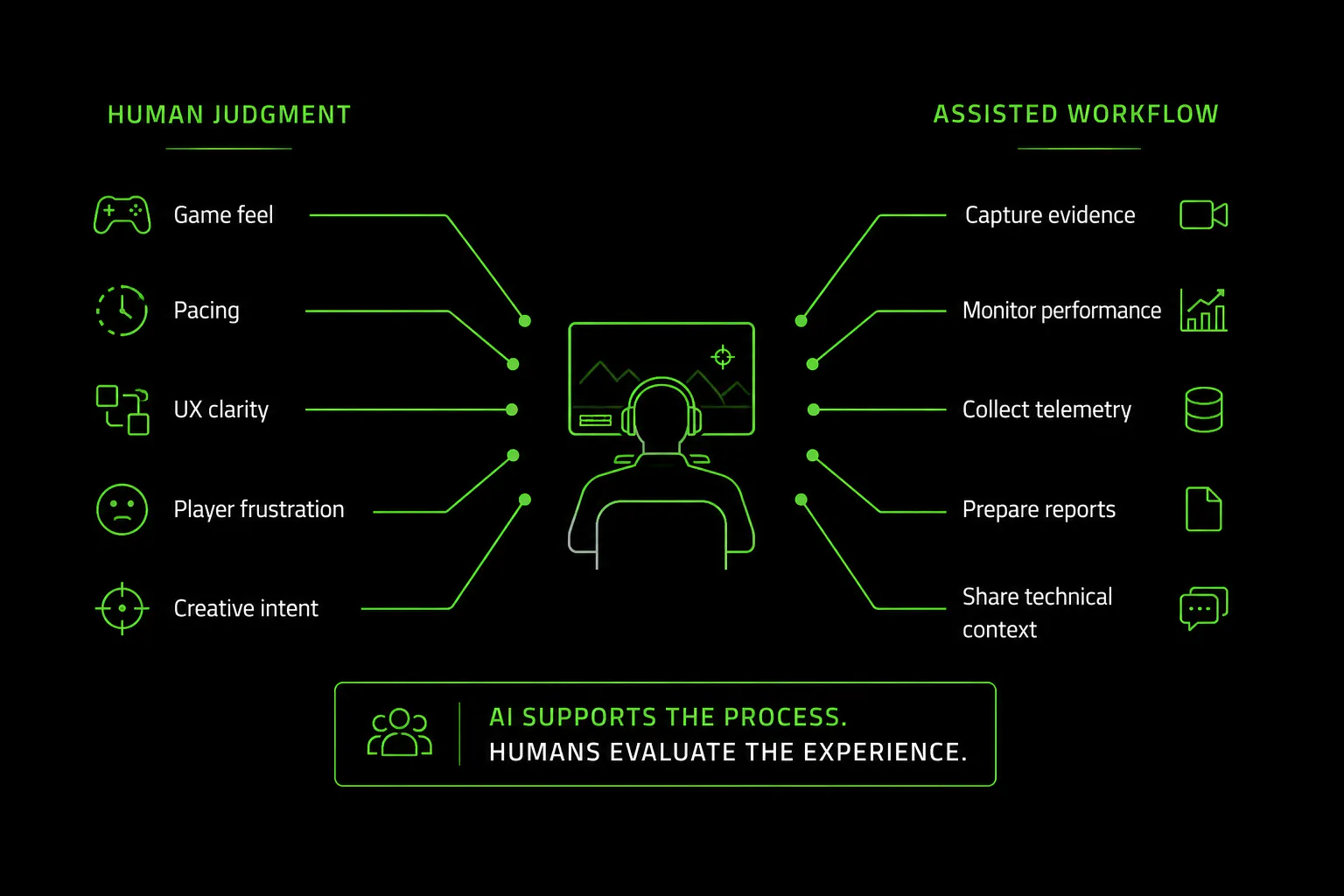
Experienced testers do far more than identify technical failures.
They recognize when combat feedback feels inconsistent. They notice when a progression loop becomes exhausting after repeated play. They identify unclear UX flows, pacing problems, awkward onboarding, or subtle interactions that technically “work,” but feel wrong in practice.
A system can detect a crash or flag a frame drop.
It cannot reliably determine whether traversal feels satisfying, whether players understand a tutorial naturally, or whether a boss encounter creates frustration for the wrong reasons.
Games are ultimately experiential systems and human interpretation remains central to evaluating them.
What AI-assisted QA changes is not the role of the tester itself. It changes the amount of manual overhead surrounding the tester’s work.
Modern QA teams spend significant time reproducing issues, collecting gameplay evidence, writing reports, attaching logs, gathering telemetry, and communicating technical details between QA and engineering.
Those tasks are necessary, but they are not where human expertise creates the most value. That is where assisted workflows begin to matter.
The Real Bottleneck Often Starts After the Bug Is Found
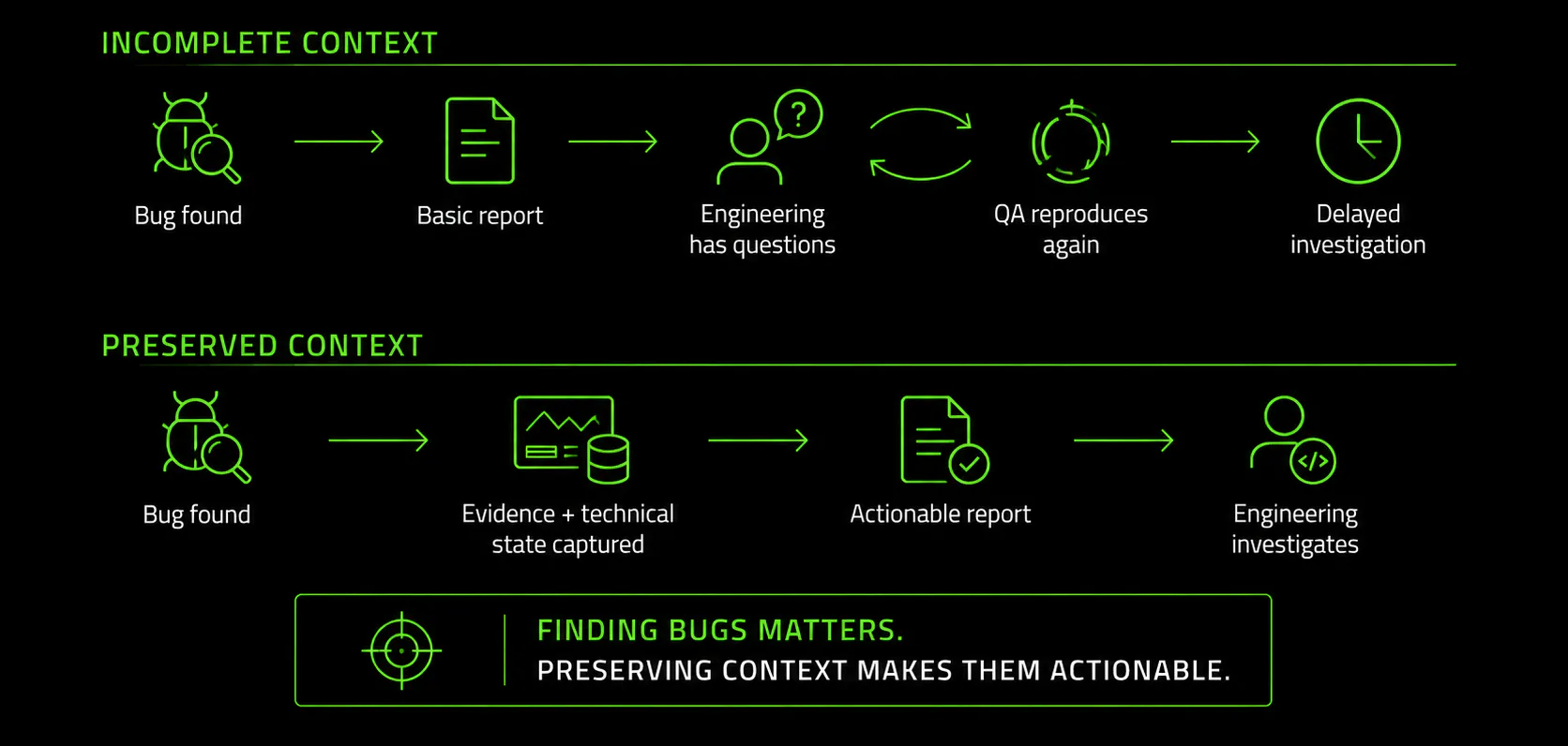
A surprising amount of production time is lost not on discovering issues, but on reconstructing them afterward.
A bug report without enough detail may bounce between QA and engineering several times before anyone can act on it confidently. A performance regression might appear only under specific gameplay conditions that nobody has fully documented. A gameplay sequence may fail intermittently, leaving developers without enough runtime data to isolate the root cause.
These situations are expensive because they interrupt flow across multiple teams simultaneously.
Engineering waits for more information. QA attempts to reproduce again. Producers lose visibility into issue severity. Designers struggle to understand whether a problem is systemic or isolated.
As projects scale, these inefficiencies compound.
This is why many studios are becoming less focused on pure bug volume and more focused on diagnostic quality: how clearly and reproducibly an issue moves through the game development pipeline.
Finding bugs matters.
Preserving the surrounding gameplay and technical state matters just as much.
What AI-Assisted QA Actually Means
One of the biggest misconceptions around QA automation is the idea that it attempts to automate creative judgment.
The more practical implementations are far less dramatic.
Most useful systems focus on three things:
The more practical implementations are far less dramatic.
Most useful systems focus on three things:
- preserving gameplay evidence
- monitoring runtime performance
- reducing manual documentation work
In other words, the value comes from reducing ambiguity rather than replace human evaluation.
Context Capture During Gameplay
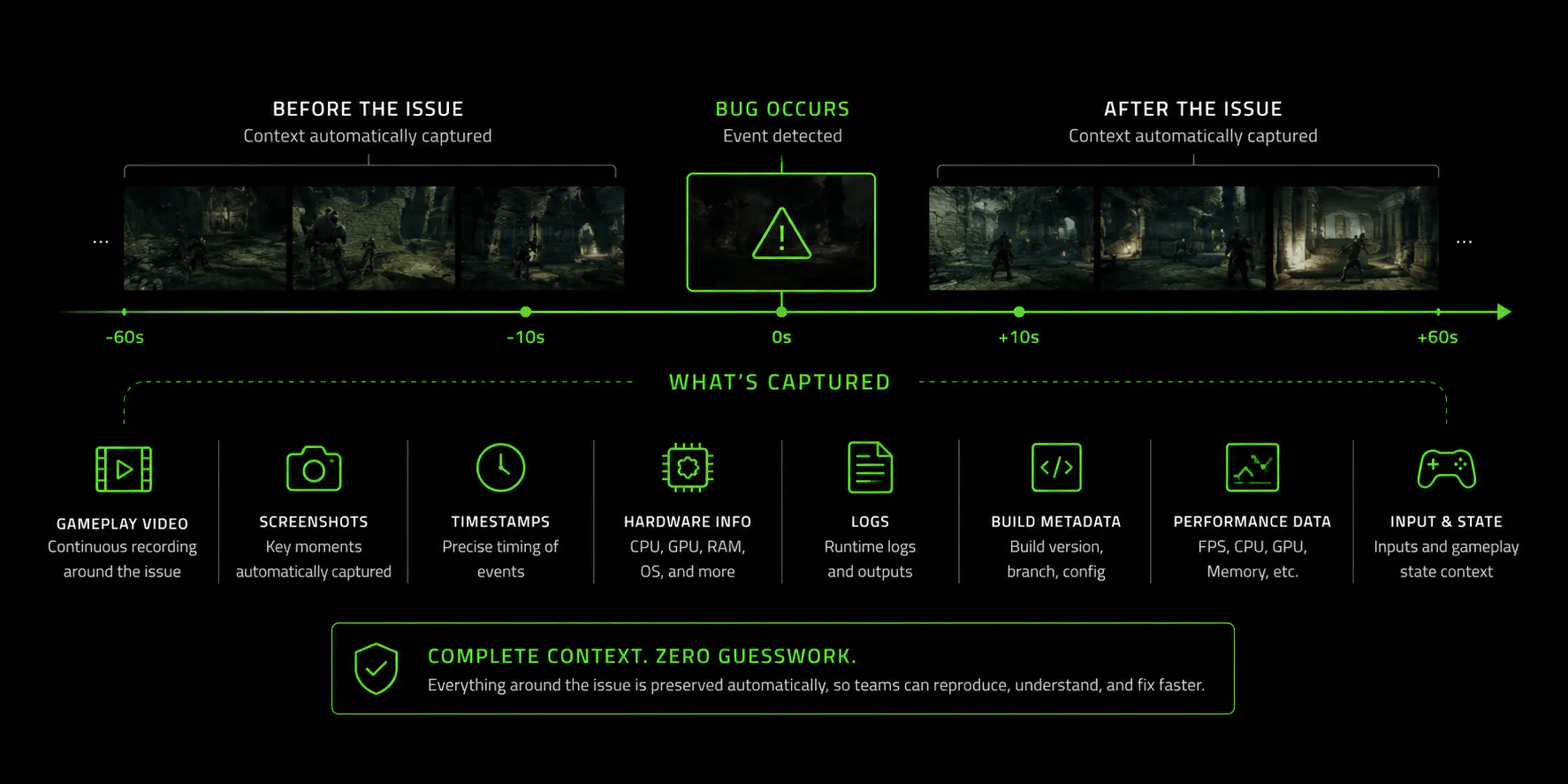
One of the most common problems in QA is missing information around an issue.
What happened before the bug appeared? What build was running? Did memory usage spike beforehand? Was the issue tied to a specific gameplay state, hardware configuration, or sequence of inputs?
Traditionally, much of this information has to be gathered manually after the fact.
That approach works — until it doesn’t.
Modern assisted QA workflows increasingly automate parts of this capture process during gameplay itself. Depending on the tooling, that may include:
- gameplay video
- screenshots
- timestamps
- hardware information
- logs
- build metadata
- FPS, CPU, GPU, and memory telemetry
- surrounding gameplay context before and after the issue
This becomes particularly valuable for intermittent bugs, crash reproduction, and performance instability, where recreating the issue alone may already consume significant development time.
The important shift here is toward automatically preserving technical evidence before it disappears.
The important shift here is toward automatically preserving technical evidence before it disappears.
Continuous Performance Visibility
Performance problems are particularly difficult to track consistently through manual observation alone.
A tester may notice a visible frame drop, but many performance regressions are more subtle. CPU spikes, GPU instability, memory growth, and FPS drops can emerge gradually across long play sessions or specific gameplay conditions. These issues become dangerous because they often remain invisible until late in development. Continuous monitoring changes that dynamic.
Instead of relying entirely on human observation, AI-assisted QA systems can monitor runtime performance during gameplay and preserve diagnostic data whenever predefined thresholds are breached.
For example, a QA workflow can track FPS, CPU usage, GPU usage, and memory consumption in real time. When predefined thresholds are breached, the system can flag the issue and preserve the surrounding context for later review.
That does not replace dedicated performance testing or optimization work. But it gives teams earlier visibility into technical instability before it evolves into a late-stage production problem.
For smaller teams especially, that matters.
Smarter Bug Reporting Workflows
Another major improvement comes from reducing manual reporting overhead.
Bug reports are only useful when they are clear, complete, and actionable. But writing high-quality reports takes time, especially when testers need to collect screenshots, recordings, logs, reproduction steps, system data, and project metadata separately.
AI-assisted QA workflows can streamline this process by generating structured reports, attaching relevant evidence automatically, linking gameplay recordings and crash data, and populating build or session information directly inside the ticket.
The tester still validates the issue and provides the gameplay context that automation cannot interpret on its own.
But the documentation process becomes faster, more consistent, and easier for engineering teams to act on.
That consistency matters.
It reduces back-and-forth communication, shortens triage, and helps teams focus on solving the problem rather than reconstructing what happened.
Traditional QA Workflow vs. AI-Assisted Workflow: A Practical Scenario
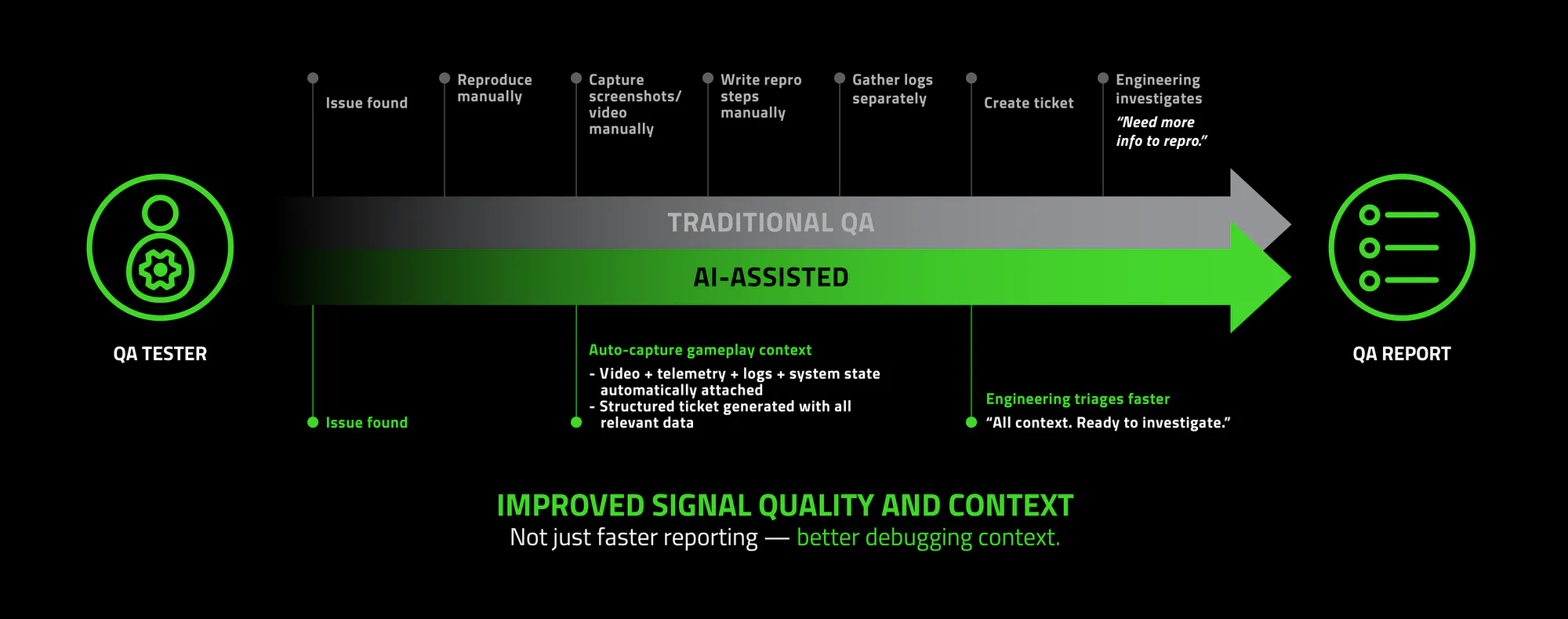
Consider a fairly common production scenario.
A tester encounters a severe FPS drop during a combat encounter late in a long play session.
A tester encounters a severe FPS drop during a combat encounter late in a long play session.
Traditional workflow
The tester notices the issue and attempts to recreate it manually. They capture a screenshot, try to remember what happened beforehand, gather logs separately, write reproduction steps, and submit a Jira ticket.
Engineering investigates, but several questions remain unclear:
Engineering investigates, but several questions remain unclear:
- Was memory already degrading earlier?
- Did the issue begin after a specific enemy spawn?
- Was GPU usage saturated?
- Did the issue appear only on that hardware configuration?
- What happened immediately before the drop?
QA may need to reproduce the issue again before debugging can continue.
AI-assisted workflow
The tester still identifies the issue.
But surrounding gameplay context is already preserved automatically: gameplay footage, telemetry, hardware data, timestamps, logs, and build information.
A structured ticket can be created with richer context, giving engineering a clearer path to reproduction and triage.
Engineering begins investigation with full evidence, reducing the amount of reconstruction required before actual debugging starts.
That difference becomes increasingly important as projects grow in complexity.
The improvement is not simply about speed—it is about improving the quality and completeness of the signal moving through the production pipeline.
Where AI Fits Into the Existing Pipeline
For AI-assisted QA to be useful, it cannot sit outside the team’s workflow.
Studios already have established production habits: internal playtests, milestone validation, regression passes, Jira workflows, build reviews, external QA cycles, and communication between QA, producers, designers, and engineers.
A useful AI-assisted QA system should support those habits, not force teams to rebuild them.
The best place for AI is often inside the moments where context is usually lost:
- when a tester encounters an issue but did not record the previous 20 seconds
- when a performance drop happens during normal gameplay
- when a Jira ticket lacks enough evidence
- when a gameplay sequence breaks but the cause is unclear
- when engineering needs more context than the written report provides
In those moments, assisted QA does not change who owns quality.
It improves the information available to the people already responsible for it.
It improves the information available to the people already responsible for it.
Why This Matters for Small and Mid-Sized Studios
Large AAA studios can sometimes absorb inefficient workflows through sheer scale. They have dedicated QA departments, internal tooling teams, and specialized infrastructure built over years of production.
Smaller studios usually do not.
Many independent and mid-sized teams are expected to maintain quality across multiple platforms, validate increasingly complex systems, move rapidly between milestones, and manage production with limited QA resources.
Under those conditions, even small workflow inefficiencies become expensive.
AI-assisted QA offers these teams a way to scale visibility and consistency without requiring a massive increase in headcount.
It can help reduce repetitive overhead, accelerate validation cycles, improve engineering efficiency, surface issues earlier, and maintain quality standards under production pressure.
or many studios, this is less about replacing labor and more about making existing teams more sustainable by reducing the amount of production energy lost to ambiguity.
The Future of Game QA Is Hybrid
The most realistic future for game QA is probably not full automation.
Game development is too creative, too systemic, and too dependent on human experience for that.
What is emerging instead is a hybrid model where human testers remain central, while AI-assisted systems reduce repetitive overhead and preserve production evidence more effectively.
Studios are not searching for a machine that understands games better than people.
They are searching for workflows that help teams move faster, communicate more clearly, and spend less time reconstructing technical problems from incomplete evidence.
The studios that adapt successfully will not necessarily be the ones automating the most, but the ones creating workflows where testers, engineers, designers, and automated systems work together efficiently.
Because modern QA is no longer just about finding bugs.
It is about capturing the right context, surfacing the right signals, and turning gameplay data into actionable insight across production before valuable context disappears.
Sergio Schiavo, Technical Account Manager